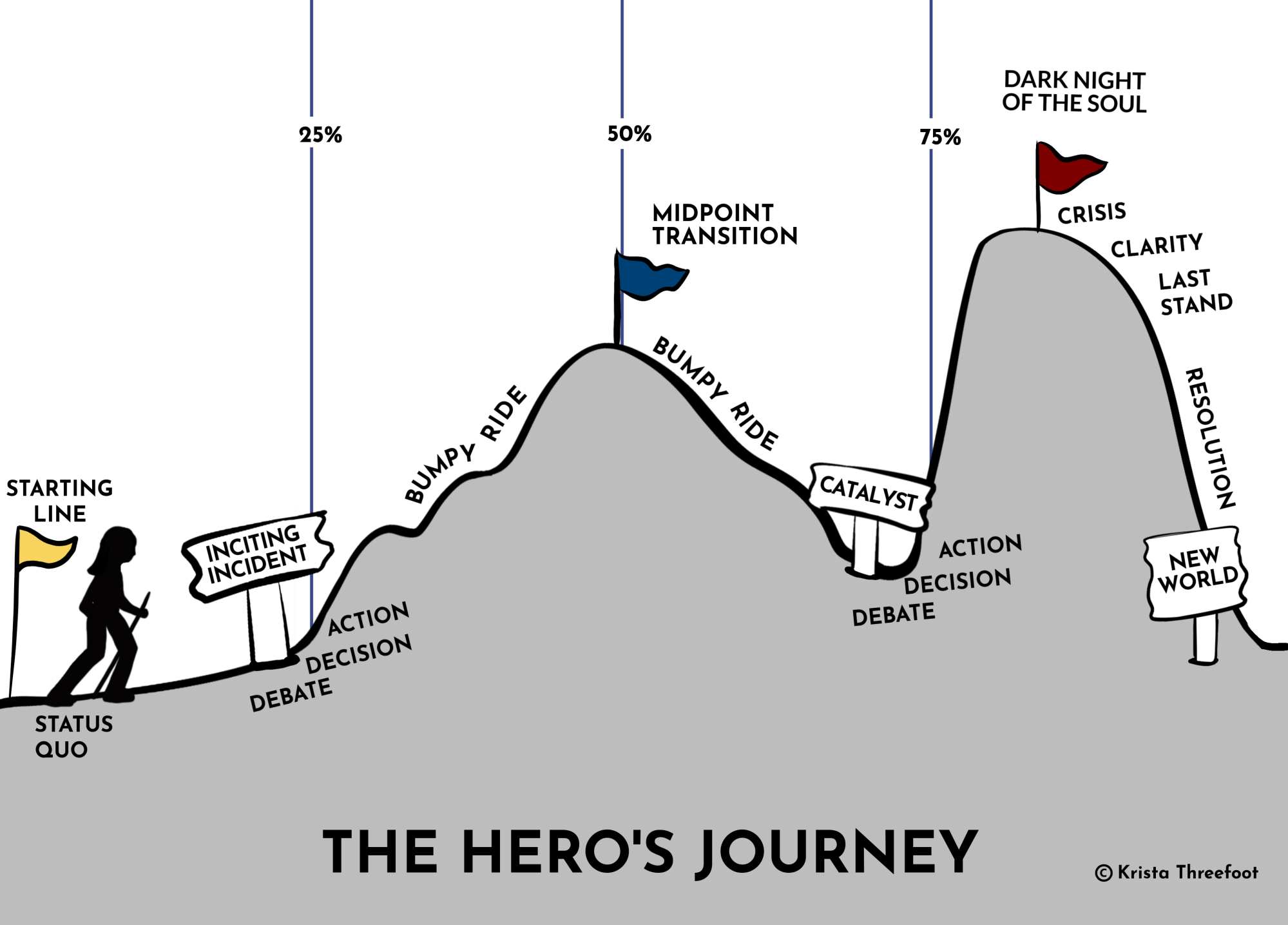
Jessica Brody’s Save the Cat! Writes a Novel is a phenomenal resource to lead your hero through the ups and downs, the turn-arounds, the all-is-lost moment, all the way to the surprising but inevitable conclusion without letting them wander into oblivion. Save the Cat is a staple on my bookshelf, but I also love a good graphic to help me visualize the main action driving my story.
The expert guidance lives in Jessica’s book, but here’s my quick take on each point on the path.
Starting Line/Status Quo
This is the BEFORE world where our hero’s problem originated. It takes up about 20% of the novel, setting the stage for the incident that changes everything.
Inciting Incident
This is the flame that lights the fire under our hero’s feet. The big event that changes everything and triggers the internal debate about what they should do and their decision to take the action that propels them into their AFTER world. In a well-paced novel, the decision to act happens about 25% into the story.
The Bumpy Ride
During the bumpy ride, our hero adjusts to their new reality, acting and reacting to the challenges and triumphs that guide both their external plot and internal growth.
The Midpoint Transition
About halfway through the story, things change for our hero. If their bumpy ride brought more challenges than triumphs, something happens to make things (appear) better. If life has been going their way, the tides turn against them. No matter what direction things take, the midpoint transition triggers the second bumpy ride and affects how the hero reacts to the final catalyst.
Catalyst
The catalyst is the big, bad event our hero has been hurtling toward from the moment they set out on their journey. It’s usually related to decisions they’ve made, problems they’ve been avoiding, the culmination of external forces holding them back, or the antagonist taking the upper hand. It happens at the 75% point and triggers the next debate, decision, and action.
Dark Night of the Soul
This is the moment when all seems lost. The hero is losing, either to their external foe or their inner demons. They are in crisis, which forces a moment of clarity, in which they realize they’ve been solving their problem the wrong way. This epiphany inspires them to change tactics and take one last stand.
Resolution
Now that our hero is solving their problem the right way, they’re able to emerge (at least partially) triumphant. Their life isn’t perfect, but they experienced an internal change for the better, which makes them stronger and more prepared to handle their challenges.
The End
Our hero’s story is over and we, the readers, walk away satisfied and hoping for a sequel.
Every writer is familiar with feelings of self-doubt. I don’t think you can even call yourself a writer if you haven’t agonized over your talents, skills, authenticity, purpose, or place in the universe.
That’s not a bad thing. In fact, much like a colonoscopy, self-doubt is a vital, if unpleasant, diagnostic tool. If we can’t probe our insufficiencies, we can’t grow. Constant questioning is a writer’s driving force.
But when self-doubt infiltrates our sense of value, it becomes a bully instead of a tool. It makes us see ourselves as imposters. It tells us that gatekeepers determine our worth. It tricks us into believing our voices don’t matter, will never matter.
These thoughts are destructive. When we let self-doubt flourish, it stifles our creativity, which can slow our progress and prevent us from reaching our goals. Eventually, it can extinguish our motivation.
I know how damaging this cycle can be. Insecurity is my forte, and it has hampered my writing for years. Engaging with writing communities and seeking support from mentors and friends has fired up my self-confidence and enthusiasm, but ultimately, we can only conquer self-doubt from within ourselves.
Knowing why we write gives us a touchstone no one else can take away.
This is where the writer’s manifesto enters the scene. There’s no single way to use this tool, but each manifesto shares one important quality: it helps a writer examine the soul animating their writing practice. Knowing why we write gives us a touchstone no one else can take away.
For people who stay motivated and inspired by measuring their progress, a manifesto can be a list of goals. Others approach their manifesto as a way to explore and articulate their personal writing philosophy through journal entries or even a personal essay. But most people create a series of affirmations that validate both their creative spirit and the value of the stories they have to tell.
Finding your NEED
Whatever approach you take, the first step in creating your manifesto is to ask yourself why you write—what need does your writing fill? Pull out one of the notebooks we all have stashed in our bookshelves and explore what compels you to write. Dig deep, and don’t allow yourself to be distracted by what you want—publication, fawning fans, a blockbuster movie deal are glorious things to desire, but those dreams don’t equate the inner urge that drives you. There’s always more.
When I asked myself this question, I discovered I need to write because I process my emotions and my understanding of the world through stories. Once I understood that, I could let go of the belief that external sources are the arbiters of my worth as a writer. Whether agents or publishers love, hate, our laugh at my stories doesn’t determine their importance. My stories matter because they fill my need. This realization alone was a breakthrough.
Finding your LIMITATIONS
Your next step is to identify the external distractions that are unavoidable, like work and family, and those you can let go of, like spending too much time on social media or reading the news. Our world is full of things that take our attention away from our writing. Even worthy activities, like volunteering, can be distractions. Our time is limited, and we have constantly to choose to prioritize our growth as writers.
Then examine your internal stumbling blocks, like lack of confidence or procrastination. These factors can be just as powerful in limiting our creativity and time as the things that come at us from outside.
My fatal flaw is perfectionism. I want every word to be exactly right before I move to the next—something no one can achieve in their first (or second or third) draft. The more I focus on the language, the more I lose sight of the critical aspect of fiction—the story! To remind myself of this, I made embracing imperfection a main tenet of my writer’s manifesto.
Finding your ACTION
Once you understand why you need to write and what is holding you back from fulfilling this need, it’s time to consider how you can better support yourself as a creator. Think of yourself as your own mentor, someone who’s there to both challenge and encourage you. Ask questions—and come up with concrete actions you can take to stay on track. These specific actions may not make it into your manifesto, but it’s important to write them down and hold on to them.
Where can you be gentler? Find the place where your inner critic bullies you most and fight back with the kind of encouragement you’d give your best friend.
Where do you need to be firmer? If you’re someone who makes excuses to avoid writing, let your inner voice become the coach that pushes you to try harder.
What can you do to encourage yourself? One thing that helps me is setting small goals and celebrating each one when I meet it. When I was writing the first draft of the manuscript I’m querying, my daily goal was 250 words. At the end of each week, my daily average always surpassed that goal, and the fulfillment and pride I felt in the accomplishment fueled me to keep going.
What strategies can you use when you get stuck and frustrated? Author and writing teacher Sarah Aronson highlights the power of play. When you just can’t find the words, try something else. Write a silly poem, put your hero in a funny situation, or find writing prompts and come up with the most ridiculous story you can imagine. If you enjoy other creative activities, like sketching, or crafting, or cooking—do them! And never underestimate the power of a quiet walk or long shower to trigger creativity when it eludes you.
Writing your Manifesto
Now that you know who you are as a writer, it’s time to write your manifesto. If you’re goal-oriented, your manifesto can be measurable tasks related to your project, using “I will” statements. For example, “I will write 250 words a day, and to accomplish that goal, I will wake up an hour early.”
For those who prefer a narrative approach, try writing a short essay or journal entry where you establish your need, your limitations, and the actions you can take to stay motivated. This method is highly personal—only you know your own story as a writer.
My own manifesto is a series of affirmations, which is the most common form. Although everyone’s motivations are unique, this type of manifesto is easy to adapt from templates that come from other writers.
What works for me won’t work for everyone, but I’ll share my own manifesto to help you get your juices flowing.
I will define myself as a writer.
As a writer, I will see myself as a creator of good in our world.
I will allow myself to nurture my creativity without guilt.
I will embrace imperfection.
I will ignore my inner critic.
I will allow myself to play, especially when I feel stuck.
When I experience writer’s block, I will open myself to other creative endeavors.
I will allow myself to feel frustrated and discouraged, but I will not allow those feelings to stop me from pursuing creativity.
I will not allow gatekeepers to limit my faith in the importance of what I have to tell the world.
I will remind myself to focus and prioritize my writing.
I will strive to feel graciousness instead of envy when other writers succeed.
I will strive to view criticism as a gift.
I will be my own cheerleader, with enthusiastic support for myself as a person with a voice that should be heard.
Look back at the last few paragraphs. Did you catch the easter egg? The process of creating your manifesto contains some of the critical elements to developing a fictional character and their story.
Every hero has a driving need.
Every hero has external and internal forces that hold them back.
Every hero takes actions to overcome the obstacles that keep them from meeting their need.
 KRISTA THREEFOOT